 EN
EN

Explore Meet Act Repeat
Chapter 1: How the story began.
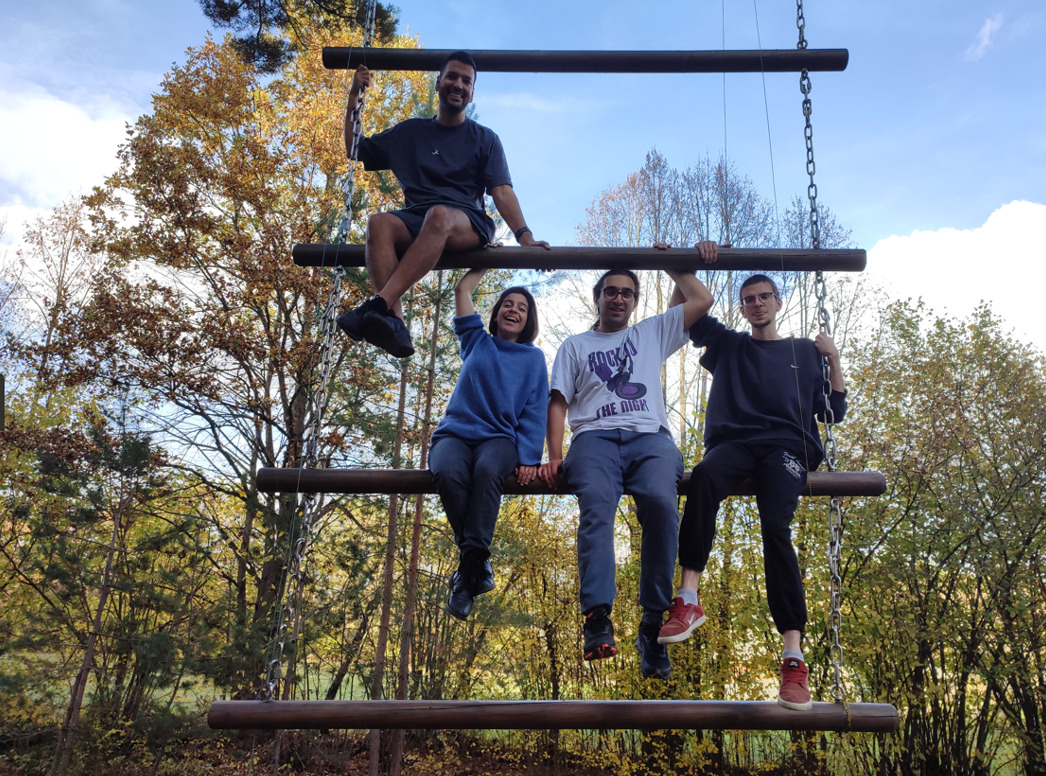
Greek team’s story begins at the airport of Thessaloniki, where 4 out of the 6 participants of the greek team met each other for the first time. After some chatting and some jokes, we arrived at Zagreb, where we finally met the last 2 participants from Greece. A few hours later we arrived at Gospic and two team leaders took us to the place where we would spend the rest of the project. We took a walk in the nearby forest and we waited for the rest of the participants. Whenever a new team would come, we would go meet them and do some small talk, so we could have a first impression.
Chapter 2:
Starting activities and knowing each other.
The project began with some activities like telling
names and hobbies, so we could learn some basic things and ‘break the ice’. We
spent some time in the main haul, chit chatting and playing some outdoor games,
with the main goal to cooperate and bond with the rest of the people in the
project.
Chapter 3:
Into the project.
After a day or two we were comfortable with the other members, we were friends, we would spend all the day together, going out on walks, cooking dinners and playing all kinds of games as a team. We worked all together to form a questionnaire and with the help of the Croatian team, we went out in some Croatian villages and asked people about their recycling habits. When the questionnaire was completed and we had all the answers, we gathered all the statistics and came to a conclusion. Apart from the questionnaire we did some dumpster diving, we tracked down the materials that were thrown in the rubbish bins and what exactly these materials were (plastic, glass,organic waste etc.). These activities were done mostly in the mornings, because when the sun was going down, we would gather in the main haul to sing, dance and learn things about each country’s culture and tradition and of course we all exchanged local food and snacks.
Chapter 4: Deeper
bonding.
As the project was coming to an end, we suggested to the team leaders to spend an entire day out in the forest. They agreed and after some preparation they provided us with sleeping bags, spoons and forks, some mattresses and even an axe. We arrived at the campfire place early in the afternoon and we ate all together after preparing the meal and dividing it equally. We even did some meditation, so we could achieve mind peace and a deeper connection with the forest that we were surrounded from. Some hours later we had dinner. We all sat together in a circle and in the middle we lit a fire after cooperating with each other to gather the resources. The forest was quiet and no city lights would prevent the eye from seeing the crystal clear sky, brightened by hundreds of stars visible from the ground level. We spent some time watching them and telling some nice stories, before heading to our tents and trying to sleep all together, so we could warm our bodies because the weather was really cold and humid. The next day we went back to our beloved shelter to continue the journey.
Chapter 5: The
last goodbye.
Finally, after one week of bonding, playing, eating and living together, it was time to head back to our countries. The last hours of our stay in Croatia were melancholic and nostalgic. We stayed till early in the morning around the fireplace outside, we sang and thanked all the participants individually for this experience. Most of our friends were crying, not because of sadness but because they were grateful that they had the chance to experience a strange and different form of friendship. One by one, exactly as the teams arrived, they left to go to the airport. We said a last goodbye before going in the bus and leave, full of new knowledge and memories.
Follow up
project
So, after returning back home safe and full of new experiences and beautiful moments, it was the Greek team’s take action, So we decided to form a questionnaire about the management of house waste and recycling. The six members of the team discussed and decided which questions are the most suitable to ask Greek citizens.
To begin with, the questionnaire was divided
into two parts. In the first part, people were asked to fill in demographic
information such as gender, age, level of education(secondary school, high
school…), area of residence( city, village…) etc. In the second part, they were
asked about their waste management habits.
Everyone was willing to participate. After
three weeks, 100 answers both in person and online were gathered. With this information, we were able to draw some conclusions about the most important
problems and difficulties of recycling in Greece
General info
From the
100 answers we got, 82% are young people aged 19-25 years old, and 82% live in a city. 73,7% of the participants are studying - or have taken a
university degree, while the 21,2% are high school graduates.
Most people
nowadays are getting informed from the internet (84%) about the impacts of
their waste and why to recycle, and many of them are taking action with
recycling usually.
Also,
another 54 percent, is getting informed about these issues from their social
environment (family/friends)
Fortunately, as shown in the pie below, 66% of the people separate their trash often and always in order to recycle, and only a 12% percent never recycle. However, we believe that this result is biased, and less people actually recycle often and always as said. We believe this because the answer that you always recycle is the socially accepted answer, and a lot of people could exaggerate about how much they actually separate their waste.
How easy is the waste separation on a scale of one to five?
(1. difficult and 5.very easy), 65% answered 3 and 4, while only 6% answered 5. This means that most of those who separate their waste and who are sufficiently informed don't have any big difficulties.
Also, about
85% of the people reuse their glass glassware, little less plastic packaging
(63%), and one in two people reuse paper boxes (50%).
Also,
people face some problems with the waste that they do not know where to
dispose, such as electronic devices, cooking oil, wood, glass containers,
toilet paper, receipts, batteries, non-recyclable plastic, mixed materials, and
organic waste.
Disposal of
organic waste is very important in Greece, and because there are not enough
composting dustbins (or none at certain cities) the organic waste is usually
dropped with the general waste (82%) - and that is a shame because organic
waste is the easiest to handle and can turn to fertilizer, without any cost.
A small
percentage of people (23%) say that they have observed illegal burn of trash in
their areas, but most people don't think this is a problem.
In the
question, if there is a problem in your area related to waste handling, there
are lots of answers blaming the local municipalities supporting that blue
recycling bins trash, actually end up in the general waste. Also, a lot of
people complain about the lack of brown bins (for organic waste) and the rare
collection of waste by the garbage trucks.
Finally, to
the question ‘Have you observed any changes in the environment the last few
years’, most answers were pessimistic, saying they have observed extreme
weather events, raise of temperature and decrease of biodiversity, but the
positive aspect is that now people have a more ecological conscience.
In
conclusion, we believe that the waste handling situation in Greece needs a lot
of improvement. We believe that at first, municipalities should inform more the
people about why recycling is so important. Also that people will have to trust
the local municipalities, so all recycling processes must happen with clarity.
Finally, it should be more clear on how electrical devices etc can be recycled,
and also to start doing work about the organic waste as well
Share