 EN
EN

Green is Easy: Metabook
Imagine a world where books aren’t single-use objects, where they don’t just stack up on shelves but are living carriers of knowledge and imagination, renewing people with their ideas and stories, hand to hand, over and over. In this world, every book is a story read and loved by different people, living many years instead of being a decorative item on a shelf or tossed into a recycling bin. The reuse of books is a true conservation of resources—an essential contribution to sustainability and the reduction of ecological impact. When a book is read again, it reduces the need for new printings, meaningless paper, ink, and energy use, which saves natural resources from unnecessary consumption. With this vision, libraries, book swaps, and platforms like Metabook become bridges connecting people through shared values, inspiring them, and helping them to learn and journey through the pages of a book. This is the world of sustainability and circular economy, where preserving knowledge and the environment go hand in hand toward a better future.
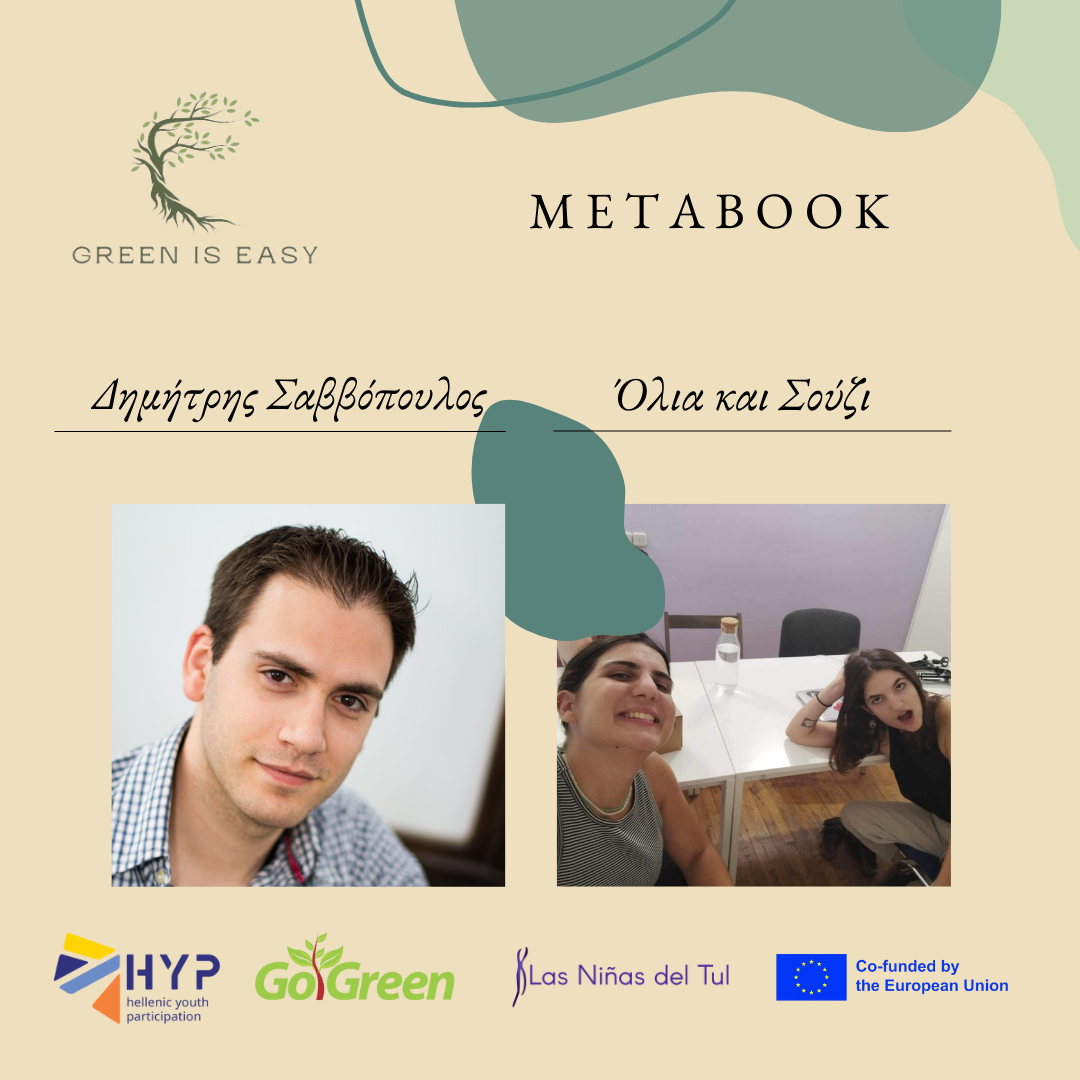
In the first episode of our podcast Green is Easy, we had the opportunity to talk with Dimitris Savvopoulos, founder of Metabook, who shared his perspective on the importance of the circular economy with a vision for a world where books are read over and over. Metabook, a Greek platform for buying and selling used books, promotes sustainability by giving books a second life. The discussion revealed many interesting practices we can adopt so we, too, can say that “Green is Easy.”
Dimitris’s journey began with a quest to make his life more sustainable with less waste. After reading Bea Johnson’s Zero Waste Home, he was inspired by the idea that we can use our books repeatedly instead of treating them as disposable objects. Books could become goods that share their richness and knowledge many times before they’re no longer needed.
Dimitris Savvopoulos, founder of Metabook, shares his vision for a world where simplicity makes a difference. “We designed Metabook to be extremely easy and simple, so that anyone could use it,” he says. The easy-to-use platform encourages people to exchange books without any hassle, bringing together those who want to share and receive knowledge. Simplicity is not a random choice—it’s the key that allows people, regardless of their technological familiarity, to contribute to a more sustainable lifestyle by giving value back to books and reducing environmental impact. In this way, Metabook highlights the value of reuse, making access to knowledge easy and sustainable for everyone.
Since its inception, Metabook has chosen to operate remotely, without physical offices. “Each member of our team works from their own space,” says Dimitris, avoiding fuel consumption and unnecessary commuting. This practice not only helps reduce time and costs but also eases road congestion and saves energy from buildings that would be left empty after hours.
Additionally, the platform invests in efficient technologies. Dimitris explains that the website’s code is written with energy efficiency in mind, reducing resource consumption. The company’s financial incentive is directly linked to reducing energy costs, aligning profitability with reducing environmental impact.
Metabook’s success is based on an incentive system that fosters collaboration among the company, sellers, and buyers, while also making a meaningful impact on sustainability and culture. Metabook recycles thousands of books daily, giving them a new life and moving them out of dusty libraries. This wouldn’t be possible without an organized system aligning everyone’s incentives. The company’s financial goal of profitability is directly linked to its impact on the circular economy: “We’re paid based on sales—we take 10% from each sale,” explains Dimitris. This means that the platform’s profitability depends on how well sellers and buyers engage in this book recycling process. The more people choose to sell and buy used books, the greater the volume of sales and, in turn, the benefits for both the platform and the environment. Metabook functions as a cycle of benefits, where everyone has an incentive and advantage: sellers earn from sales, buyers find the books they’re looking for, and the company strengthens along with the circular economy. This approach creates a positive ecological footprint and contributes to culture, offering a new perspective on consumption and respect for the environment.
Metabook, through these conscious choices, demonstrates how a business can achieve economic sustainability while remaining true to environmental values, setting an example for a greener and more responsible business future.
Listen to the podcast here
--> Find the script of the podcast here
Green is easy was co-funded by the European Union and the Greek National Agency "Youth and Lifelong Learning Foundation"
Funded by the European Union. Views and opinions expressed are however those of the author(s) only and do not necessarily reflect those of the European Union or the European Education and Culture Executive Agency (EACEA). Neither the European Union nor EACEA can be held responsible for them.
Share