 EN
EN

Step Into Branding: Roes & You in Europe
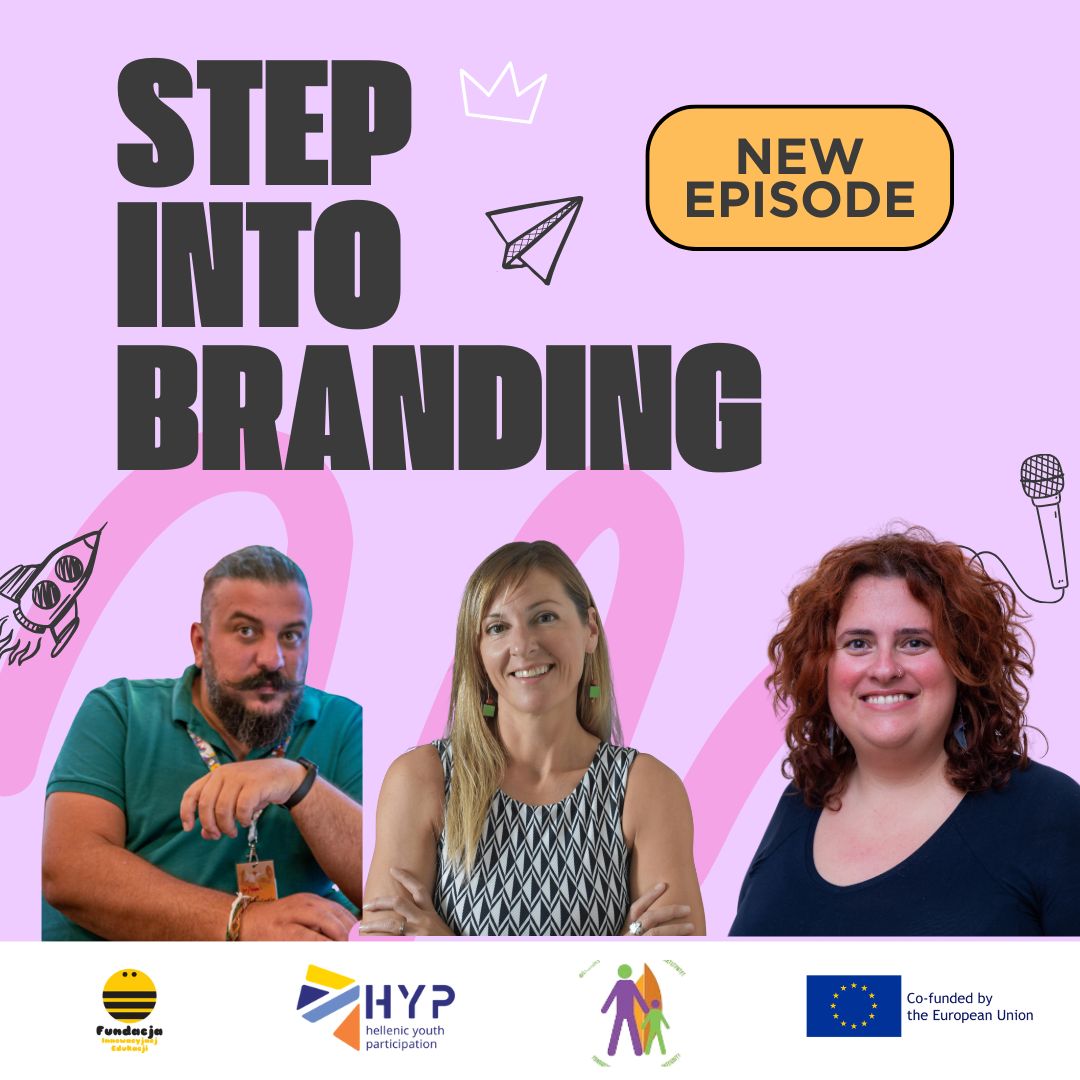
In the field of adult education, communication seems to be one of the most important challenges that organisations encounter. Step into Branding is a project that aims, precisely there, to support adult education organisations so that they can acquire more knowledge about shaping their brand, given the increased demands of the modern era, as well as the ways in which they can increase their impact.
As part of the project, the production of a short but meaningful podcast and vidcast series was implemented, where representatives of organisations spoke honestly about their experiences, revealed some of the challenges they have faced and shared the strategies that helped them evolve. We had the opportunity to chat with Stavroula Pagona from You in Europe and Panagiotis Mamouzakis from Roes Cooperativa . Both of these organisations are practical examples that show us how a branding strategy can be successfully implemented.
The discussion that took place with both Stavroula and Panagiotis highlighted the difficulty but also the importance of stability. Both representatives pointed out that it is extremely important to stick to a schedule, "We have 11 different types of posts, which are somewhat structured, and have specific days that they are uploaded. That is, our news will be uploaded on Friday and Tuesday, on the weekends we will mainly post some testimonials," says Panagiotis. There should be a stable, high-quality presence on as many platforms as each organisation can be on, adds Stavroula, so that a relationship of trust can be developed with the public. After all, the public is diverse: adult students, funding bodies, teachers, and networks of collaborators. Each of these groups has different expectations, which requires a flexible and inventive approach, in order to achieve gradual and scalable awareness and increase the impact of the organisation. "You need to have a flexible formulation of your branding, allowing you to resonate with different audiences while maintaining consistency," as stated in the program manual.
What we learned from Stavroula is the importance of clarity in our message and in our visual identity. She points out that "when the other person sees something, they must understand what they are seeing... It cannot just be a video that shows people moving and laughing without knowing what you are showing". For this reason, they invested in the construction of a new user-friendly website, which they also brought to the forefront, so as to renew, while maintaining their colours for reasons of recognition, their visual style on social media. At this point, Stavroula emphasised: "For me, it is very important now to be able to have new collaborators by your side... to be able to trust the young people who are in it, who live through their mobile phones, who are informed and have much more knowledge than us", emphasizing both the demands of the times and the contribution of young people to the team, bringing new ideas and approaches to communication.
In our conversation with Panagiotis, we learned how important it is to be inventive, innovative, and pioneering in order to stand out. He pointed out that it is very important to identify your audience and develop a persona with whom you will communicate all your messages. In this way, we come one step closer to overcoming another major challenge that Panagiotis reminded us of, "the translation of the language of subsidies." Panagiotis says, "We cannot use the harsh language that we use when we make a subsidy to reach out to the people who want to be part of this subsidy. So we essentially do a translation to this persona so that this persona can understand what we are talking about". They created 2 personas, Dimitra and Dave, so they personalized their audience and now they also use a specific social media platform for each persona, "on Facebook both of them, on Instagram only Dimitra and on LinkedIn Dave.", as Panagiotis tells us.
Storytelling could not go unnoticed, as it is a tool that both Stavroula and Panagiotis use. As mentioned earlier, the Roes have 11 different types of posts that are uploaded on specific days of the week. Similarly, Stavroula says that they apply some basic elements of storytelling daily, such as "making what you say impressive, being able to have a rhythm in the way you narrate, being able to tell your story simply, briefly and concisely."
Turning to the issue of artificial intelligence, both representatives expressed objections. Panagiotis said that it is a tool that they use to improve the image of their texts and that, personally, it makes it very easy for him, but he emphasises that it is now obvious which organisations are using artificial intelligence ineffectively, as they lose their identity and project a "standardised blockbuster". At the same time, You in Europe uses artificial intelligence in an advisory capacity, but they always use human review before making any posting.
Concluding, Stavroula and Panagiotis did not fail to provide practical advice for small organizations that may now be taking their first steps:
Create a simple, yet consistent brand with logo colors and fonts.
Identify your audience. Imagine a specific persona , such as Demetria and Dave, and speak to them directly.
Give consistency the space it deserves. Prefer to upload at least two quality posts per week, rather than seeming inactive on your channels.
Copy and evolve good practices.
"Be clear and lucid and be able to let the other person understand your essence in simple words," advises Stavroula.
You have the ability to use free and very creative tools, such as Canva and CupCut for videos.
Take advantage of the possibilities and human resources you have, with humility, experimentation and collaboration .
Don't be afraid to ask for help. "Search, see successful examples, get feedback," suggests Panagiotis.
Step in Branding, therefore, is not just about aesthetics, it is about authenticity, communication and the ability of each organisation to project its identity in a way that inspires its audience.
Step into Branding is a small-scale partnership implemented by the Foundation for Innovative Education, Hellenic Youth Participation, and the Foundation for "Values, Virtues, Integrity". Hellenic Youth Participation is a lifelong learning and empowerment organisation, with a network exceeding 60,000 people and actions reaching up to 500 people per month.
It is funded by the European Union. However, the views and opinions expressed are those of the author(s) alone and do not necessarily reflect the views and opinions of the European Union or the European Education and Culture Executive Agency (EACEA). Neither the European Union nor the EACEA can be held responsible for them.
Share